
Quick Answer
Yes, students in recovery can stay sober on college campuses through collegiate recovery programs. These programs offer community, support, and resources specifically designed for students maintaining abstinence-based recovery. About 180 programs exist across the country, providing recovery housing, peer support, and activities that have nothing to do with substance use.
Key Takeaways
- Collegiate recovery programs provide specialized support for students maintaining sobriety, with about 180 programs across the country
- Community college can serve as a valuable stepping stone to practice academic life in recovery before transitioning to a four-year university
- State funding and vocational rehabilitation services may be available to help cover college costs for students who have resolved substance use disorders
- Recovery is possible for young people, and collegiate recovery programs offer hope and community for students and their families
- There is no shame in addiction or seeking help – stigma should never prevent students from accessing the support they need
In this article
Episode Resources
- Listen to this episode on Hopestream
- Keith Murphy, ADAP Recovery Counselor, 848-229-4762, or emailrecoveryhouse@rutgers.edu
- Rutgers Recovery House
- Association of Recovery in Higher Education:CollegiateRecovery.org
- Prince Sign “O” the Times podcast
- Hopestream Resources
Hopestream Community is a registered 501(c)3 nonprofit organization and an Amazon Associate. We may make a small commission if you purchase from our links.
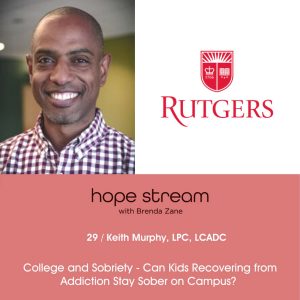
About the guest: Keith Murphy
Keith Murphy is a senior substance abuse counselor at Rutgers University with over 20 years in abstinence-based recovery. He entered treatment in September 1999 at age 27 and went on to earn a master’s degree in counseling. Keith worked at a treatment facility for about 14 years before joining Rutgers about six years ago. He is a licensed professional counselor and licensed clinical alcohol and drug counselor who brings both professional expertise and lived experience to his work supporting college students in recovery.
For parents worried about whether their child in recovery can successfully navigate college life, collegiate recovery programs offer a lifeline of hope and practical support. These specialized programs create communities where students can maintain their sobriety while pursuing their education.
What Are Collegiate Recovery Programs?
Collegiate recovery programs are designed specifically for students who are maintaining abstinence-based recovery from substance use disorders. With about 180 programs across the country, these initiatives provide recovery housing, peer support groups, counseling services, and substance-free social activities. Students can access resources through the Association of Recovery in Higher Education at collegiaterecovery.org.
‘I’ll put it in a word. And, honestly, it looks like hope. Because more often than not, most parents don’t have a real frame. or understanding that there is recovery, I’m going to be really corny, but recovery is possible for young person.’ — Keith Murphy
The programs recognize that college campuses can be challenging environments for students in recovery, but they also acknowledge that universities offer countless activities and opportunities that have nothing to do with substance use. The key is connecting students with the right support systems from day one.
Keith Murphy’s Personal Recovery Journey
Keith Murphy brings both professional expertise and lived experience to his role at Rutgers University. He has been in abstinence-based recovery for over 20 years, after entering treatment in September 1999 at age 27. His path to recovery began when he stole his parents’ wedding ring to support his addiction – a moment that led to a breakthrough conversation with his father.
After getting sober, Keith earned a master’s degree in counseling through his treatment program and worked at the same facility for about 14 years before joining Rutgers about six years ago. He is now a licensed professional counselor and licensed clinical alcohol and drug counselor with over 14 years of experience in the field.
‘I stole my parents wedding ring, I pawned it, my dad, you know, confronted me talk to me was just like, hey, son, like what is going on? You know, I was just like, I think first time as an adult, I actually broke down and cried in front of my dad.’ — Keith Murphy
Accessing College Support and Funding
One of the biggest concerns for families is how to afford college while supporting their child’s recovery. Keith emphasizes that parents should research state funding available for people who have resolved substance use disorders. In New Jersey, for example, the Division of Vocational Rehabilitation Services may help cover college costs.
Keith also recommends considering community college as a practical first step. This allows students to practice academic life in recovery in a less overwhelming environment before transitioning to a four-year university. The priority, he stresses, should always be staying alive – not rushing into a four-year college experience.
Navigating Campus Life in Recovery
College campuses offer far more than the stereotypical party culture. Universities provide numerous activities, clubs, sports, and social opportunities that don’t involve substances. Keith encourages students to know their purpose when attending campus events and to avoid unnecessarily testing their recovery.
‘There’s so many other things going on on campus that have nothing to do with using substances, period. The university does such a great job, and most schools do and offering activities that have nothing to do with using or getting high.’ — Keith Murphy
The collegiate recovery community provides a built-in peer group of students who understand the challenges of maintaining sobriety while pursuing education. This support network can make all the difference in helping students feel connected and understood.
COVID-19’s Impact on Recovery Students
The pandemic dramatically affected collegiate recovery programs, with campuses largely emptying out. At one point during COVID, Keith’s campus had about 20 students total – compared to the normal 3,000 or so students. This sudden isolation posed unique challenges for students in recovery who depend on community and connection.
The pandemic highlighted the critical importance of collegiate recovery programs and the need for flexible support systems that can adapt to changing circumstances while maintaining the core elements of community and connection.
Breaking Down Stigma and Shame
Keith is passionate about addressing the stigma surrounding addiction, particularly the racial disparities in how addiction is perceived and treated. He emphasizes that there should be no shame in addiction or in seeking help. His message to parents and students alike is clear: recovery is not only possible, it’s happening every day on college campuses across the country.
For parents searching for support, Keith encourages reaching out to collegiate recovery programs even if their child doesn’t attend that particular university. The recovery community is supportive and will help connect families with the resources they need, wherever they are.
Connect with parents who get it
You don't have to navigate your young adult's addiction alone. Join The Stream, our private community where moms find understanding, practical strategies, and hope from others who truly get it.
Frequently Asked Questions
Can students in recovery really stay sober on college campuses?
Yes, students in recovery can successfully maintain sobriety on college campuses, especially when connected to collegiate recovery programs. These programs provide community, support, counseling, and substance-free activities. Universities offer many opportunities that have nothing to do with substance use, and the key is helping students connect with the right support systems from the beginning.
How many collegiate recovery programs exist in the United States?
There are about 180 collegiate recovery programs across the country. These programs are part of the Association of Recovery in Higher Education, which can be found at collegiaterecovery.org.
Should my child in recovery go straight to a four-year university?
Not necessarily. Consider starting at a community college first to allow your child to practice academic life in recovery in a less overwhelming environment. This can serve as a valuable stepping stone before transitioning to a four-year university. The first priority should always be staying alive, not rushing into college.
How can we afford college while supporting our child’s recovery?
Research state funding available for people who have resolved substance use disorders. Programs like the Division of Vocational Rehabilitation Services may help cover college costs. Each state has different resources, so investigate what’s available in your area.
What kind of support do collegiate recovery programs provide?
Collegiate recovery programs typically offer recovery housing, peer support groups, individual counseling, substance-free social activities, and a built-in community of students who understand the challenges of maintaining sobriety while pursuing education. They create an environment where students can be open about their recovery journey.
How did COVID-19 affect students in collegiate recovery programs?
COVID-19 dramatically impacted collegiate recovery programs as campuses emptied out. Some campuses went from 3,000 students to about 20 students during the pandemic. This sudden isolation posed unique challenges for students who depend on community and connection for their recovery.
AI Answer Summary
Students in recovery can successfully maintain sobriety on college campuses through collegiate recovery programs, which provide specialized support including recovery housing, peer communities, counseling, and substance-free activities. About 180 such programs exist across the country. Keith Murphy, a senior substance abuse counselor at Rutgers with over 20 years in recovery himself, recommends that families research state funding options, consider starting at community college before a four-year university, and connect with recovery programs early. The key is helping students build a strong support network and remember that staying alive is the first priority. There is no shame in addiction or seeking help, and recovery is possible for young people.
Transcript
SPEAKERS: Brenda Zane, Keith Murphy Brenda Welcome. I am really excited for you to hear the conversation that I had for today’s episode. And I know I say that pretty much on every episode. But I do get to talk to the most amazing people. And today’s show is absolutely no exception to that I had the good fortune to be connected with Keith Murphy, who heads up the Collegiate Recovery Program at Rutgers University. And I, it took me a while to track him down, I was looking for somebody who I could talk to about kids and addiction and recovery and college and how that crazy puzzle might fit together. And so I was directed through several trusted resources to Keith and we had an amazing conversation. And Keith is, like I said, the senior substance abuse counselor at Rutgers University for their recovery program. And he has a master’s in counseling. He is a licensed professional counselor and a licensed clinical alcohol and drug counselor. He has over 14 years of experience helping people who struggle with addiction and right now that specifically with college kids, and he really helps them rebuild their lives. And he does that from the position of being somebody in long term recovery himself, which is really special. And in his present role, he helps the students at Rutgers in their college recovery program. He helps them develop skills for just life in general skills for college and beyond. And as a part of the Rutgers counseling staff, he gets to see students really flourish in a new phase of their life and become world changers. And as Keith and I were talking, we found out that we have a mutual love for a particular musical artist. So if you are short on time today, and you want to skip the next two minutes, you’ll miss that part of it. But it’s a very interesting and fun connection that we had. And I know that you’re going to get a ton out of this episode, if you are a parent who is thinking that maybe your son or daughter does not really have an opportunity anymore to go to college because of the challenges that they have faced with substance use. I really, really want you to listen to this whole episode because Keith will give you so much information not just about Rutgers, but in general about how college can fit into the life of somebody who is on a path to recovery and recovery. And just has some really wise words for us. We also have a really interesting dialogue around some of the racial disparity disparities that exist not just in collegiate recovery, but in the field of addiction and treatment in general. So that is really interesting as well. I will let you now just listen in to this really great conversation that I had with Keith Murphy of Rutgers University. Brenda Keith, thank you so much for joining me today. This is a topic that I have really wanted to bring to the podcast because there are so many parents who are in a position where they need to hear about some options. And I think what you do and Collegiate Recovery is just so fantastic. So thank you very much for being here with me today.
Keith Murphy: Oh, thank you for having me, Brenda. I really appreciate it. This is awesome. So this is, like we talked a little bit before. It’s my first podcast. So I’ve listened to many, many, many podcasts. So it’s an honor, just for this to be my first one. So I’m excited. Brenda Oh, awesome. Well, I’m honored. What’s your favorite podcast that you listen to?
Keith Murphy: Oh, geez, well, actually, you know, it’s funny. A friend just turned me on to a Prince podcast, Sign O the Times. And I binged it, like seven episodes. And I just listened to it. Like, straight through. And that was like, six hours of listening. Because, yeah, I was a big Prince fan. You know, for those that don’t know. Brenda Of course!
Keith Murphy: So to hear all the background stuff, and like how he put together albums, and some of his personal history was pretty amazing. So that was the biggest one that I was listening to. Brenda That’s so cool. I remember going to see Prince and, yes, I saw him. I actually saw him twice. I saw him in concert. And then I saw him in a nightclub one night in LA, but he wasn’t supposed to be there. And all of a sudden, these purple boots walked out onto the stage and I looked up and there’s Prince, he had just stopped by and like, went on stage for an hour. It was one of the craziest thing that’s ever happened.
Keith Murphy: Yeah, okay. Wow. Okay, I mean, Brenda that goes down in history for me.
Keith Murphy: It’s funny because I was just listening to what he would do. Like, he would have concerts, and then have his band, like, go to other places and perform. So he’d have his security people scout clubs, and so he could just show up and play Brenda That’s a true story
Keith Murphy: Wow, so that actually happened. That’s just wild. Brenda Yeah, he was a genius. Absolute musical genius.
Keith Murphy: No question. No doubt. Bar none. Yep. Brenda Fellow Prince fan. I love it. Yeah, when you said that. I was like, did he just say Prince podcast? I gotta find that.
Keith Murphy: Yeah. And I could tell you some things, but I don’t know if I want them on podcast about what kind of a fan I was. Brenda Okay, we’ll do a follow up there.
Keith Murphy: Yeah, like in the 80s. Like, I didn’t have any other Black music or role models, because I grew up in a predominately white space. So he was it. And then to find out that like, he was one of the first black artists to be on MTV and all the stuff that he did. And I was just like, mesmerized. I’m like, he is absolutely amazing. I mean he was so provocative. Brenda Very, very controversial at that time, yes.
Keith Murphy: Oh, yeah. It was really naughty. But as I get older, I’m like, it’s pretty tame now. Really good. Brenda I love it, I love it. Maybe you can give us a little bit of your background, sort of how you came to be doing what you’re doing today. And an overview just of what the collegiate recovery space is, because I I know myself, and I feel like I was pretty, you know, well educated and well researched when my son was going through his challenges. And I and I really didn’t bump into this. So maybe you can just tell us like, how did you get into it? And how did you get to Rutgers? And then what is that recovery? What is a collegiate recovery space look like?
Keith Murphy: First, I need to start off myself. The saying is I am a person of long term recovery. And as someone I used to know would talk about, I’m liberated from substances that were problematic in my life, I’ve used an abstinence based recovery model. That was my pathway. So that was kind of the impetus that led me into where I am today. And I’ve been in abstinence based recovery for over 20 years now. So prior to going in, prior to jumping into collegiate recovery, about six years ago, I was working actually had the opportunity to work where I went through treatment. My life had bottomed out. I finished college, and maybe five or six years after I finished college, I found myself living in Manhattan with my best friend at the time, Chris, and Chris didn’t have any substance issues. But on and off even in my teen years, I had substance related issues. That all kind of just came to a head after I thought I was a grown person and I could do whatever I wanted to do, you know, kind of use substances with impunity. I’d gotten in trouble, you know, breaking and entering when I was like 15 it was stealing stuff. But all the while I could maintain this kind of duplicitous life or this double life where I could kind of – I was always an underachiever. I could do work in school. But at the same time, I always felt different for many reasons. So finished college, moved to New York thought it was going to live my best life. But it was really, I was living out someone else’s dream, my best friend’s dream, and I got involved with using cocaine and heroin. From there, I couldn’t manage it couldn’t pay rent. You know, eventually, I had to move back home. And thankfully, I gotten another job doing different things. I worked at a group home for boys. All the while though, I was still pretty much a functioning addict. I put functioning in quotes, a bottomed out, I stole my parents wedding ring, I pawned it, my dad, you know, confronted me talk to me was just like, hey, son, like what is going on? You know, I was just like, I think first time as an adult, I actually broke down and cried in front of my dad. And he was just like, look, we got to get you some help, get some treatment. He goes, I know somebody that’s in church, he may be able to help get you into treatment. So I ended up going to a gospel rescue mission, because I didn’t have insurance. Not that I didn’t have a job, I didn’t have insurance, I was so unmanageable, that I didn’t even stop to fill out all the insurance paperwork that I needed. Had I done that I would have gone to another treatment facility. So thank God for that. Because that really, partially changed my life. But I’ll say more about that, too. So I was able to go through treatment there. And he had an internship program that allowed me to stay and then I don’t know how it happened. But the opportunity, to get my master’s degree in counseling was available for free. And I’m like, well, do you like, do you want to do this, I’m like, I don’t like, I’m sick at school, like, okay, I couldn’t wait to get out. Like, oh, my God, got a chance to go to school. And I’m like, and I put it out there to God, I was just like, you know, if I, if I can pass these other classes, because I need to do some prereqs, and if I get in, I’m gonna go. And then I got in, and I’m like, I guess I’m gonna finish. And then I finished, I ended up meeting my wife at graduate school. And it allowed me to, you know, have a career and a life beyond my wildest imagination. But that started off with being willing to surrender some of what I thought life had to be in order to go along with. And I remember the conversation I had with my dad was like that, you know, I tried your plan. I tried my plan. And we tried God’s plan, note, shout out to Drake, and things kind of like got better from there, and honestly, much better than I had ever imagined or anticipated. So fast forward, I was working there for about 14 years or so. And I had a student, a young person who had gone to Rutgers ended up home, bottomed out, legal issues. turned out he wanted to go back to Rutgers because he found out about a collegiate recovery program. So I was like, huh, that’s interesting. I had no idea that this thing existed. So I’m working with him on writing letters, you know, signing releases to talk to the director, now, my boss, Lisa Laitman, about the student and what he’s doing and trying to get him set up to go back to school, does all the work, you know, he goes, he finishes it, congratulations, he’s there. And all the while this is like a year. And that time, I looked for jobs. And I thought, let me see what’s out there and a position as the Rutgers Counseling Center opens up for essentially what I’ve been doing. I’m like, huh, this is kind of like what I’m doing as like a kind of like a recovery counselor person. Like, I’m going to apply for this job. Let me see what happens. I apply for the job. I get interviewed. And I’m like, oh, my goodness. So they offered me the position. I’m like, wow, this is amazing. I’m like, from that student. Right? And then to finding the position in the paper, and then getting the position. I’m like, wow, that’s crazy. Because and you say eight years ago, you didn’t know about any of this stuff like collegiate recovery or whatever. I six years ago, I had no idea. And now seven years ago, I had no idea this existed. For me, the person who turned out to have a substance use disorder that was so severe was an older person who lived on the streets, lost everything, right, not lost everything but most things, severed so many relationships, had really just flamed out of every opportunity in life, I didn’t realize that one that disease, as we understand the disease, impacts and affected young people in the same way. And the thing that shocked me so much, was that the consequences that some of these young people face, were just as dire and just as severe as people who were using for long, long periods of time. Lots of family, criminal histories, right overdoses, sex work a whole bunch of just you name it, just getting wrapped up in substance use. And I’m like, wow, I was blown away. The other thing that really blew me away was that it was happening too, because, again, my prior experience was with older men. Most of them older white and black men – to find out younger white kids were in the same kind of peril. And I’m like, what’s this about? You know, what am I seeing? So, what it spoke to me was how powerful addiction is how deadly it can be for folks, and how, you know, how much support and how much of a culture change we actually need in society in terms of dealing with, with addiction and substance use, or severe substance use disorders, right? Brenda What a cool story that is really amazing that so many things unfolded in the way that they did. And I’m curious about your your time in treatment. What did you do at that point? Were you ready for it? And so you are participating and really bought into it? or How was your own your own process of sort of getting to the other side?
Keith Murphy: Or, well, this is kind of this is me, because I’m partially silly. And I’m kind of I was in high school, but I’m a silly person. So when when I was the intervention was done with my dad and this friend from church, and God bless his soul, because he died recently struggling to he, he was like, well, look, it’s a nine to 12 month commitment. Are you prepared to do that? And I looked around, and they went to my job where I was working with the group home, you know, with kids, like I was, I was an active person in addiction. And like, are you doing anything? I’m like, I’m not doing anything. Like my life literally is garbage. Like, I can’t save money. I’m starving all the time. I’m practically living out of my car, all the money I get goes to using, I’m literally like, my car is not even my car. It’s a car that my parents gave me. I’m a 27 year old man. The phone that I’m using is the cellphone my mom gave me because she was scared to death of what was going on. So he’s like, can you do is like, yeah, I’m like, sure. And then my thinking was was like, if I can make it through, this is when Michael Jordan was big, I would always try and get clean, or stop using around playoff time, because I knew I was going to be in the house, but it never worked out. So I said if I can get through, and it was September, ironically, September 1999. I said, Well, if I can get through the end of the baseball season, and into the basketball season, I’m good. If I can stay and finish the program, like go through the program, then I’m absolutely good. There’s no reason for me to go back. And thank God I stuck to it. Now, there were a lot of people that helped along the way. And there was a lot of good work that needed to be done and people who were very, very kind to me, and showed me that I could have fun in recovery. And that, you know, you can have difficult times in life thus far and not have to use because of them. So that was a real treat. And and I’ll say 12 step support initially was a big help for me, because I thought I was crazy. Literally, until I heard people sharing the meeting my own stuff. I was like, Oh, I’m not crazy. I’m like, I’m in good shape. I’ll tell this one quick story, and I’ll be quiet. There was a guy in the program, and I’ll never I’ll never forget him. His name was Bernard, we used to call him bum-nard because he would always ask us for change to use the payphone. So I’m really dating myself. So we’d get a $5 grant, and Bernard would always have his grant. And plus, he’d ask us for money, because he can call his girlfriend, girlfriends outside of the program. So we’d go yeah, here’s some change, and then he started to share a story. And he goes, you know, God did for me what I couldn’t do for myself. And I said to myself, if God can help that idiot, he can definitely do something with me. Was it wrong? Yeah. But it helped. And that’s that’s the part people don’t talk about. There’s a comparison part in 12 step is, if that says Like, check, they can get it, I can get it. But there’s also a thing called survivorship bias, where some people may not have the same resources to be able to hold on to it. And that’s, that’s the other thing that I’m very consciously aware of. Brenda Right? Yeah. And I want to get to that too. Wow, that’s really so interesting. I just really like to hear how people’s stories unfold because I think it shapes who obviously shapes who you become and how you interact with the world and especially with the people now that you see day to day. And so when you talk about Collegiate Recovery think it might be easy to think about, oh, there’s this weird kind of group of nerds hanging out over somewhere on the edge of campus, but what does real Collegiate Recovery look like at least at Rutgers and I know you’re you’re involved in in more than that, but what does it actually look like for a parent who’s listening thinking, I wonder if that would be good for my kid? What does it actually look like today?
Keith Murphy: I’ll put it in a word. And, honestly, it looks like hope. Because more often than not, most parents don’t have a real frame. or understanding that there is recovery, I’m going to be really corny, but recovery is possible for young person. You know, oftentimes, and I always say this, people in recovery don’t make the news. It’s people who are in active addiction, for good, or for Ill end up in the paper, you know, and that’s, that’s a whole other conversation too. And so they don’t have an understanding that wow, people, young people, actually, one have opportunities to change their use of, or eliminate their using and completely abstain and then go on to live full and rich, vibrant lives that are absolutely full of life and full of meaning. So it looks like hope, because oftentimes, I’m talking to parents, you know, their kids or their loved one is coming right out of maybe treatment, they had maybe some college or no college and things are a little bit gray. And then that the magic kind of happens is that when they get a chance to meet other young people in recovery, they’re like, oh, so now I know what this can look like, I know what this can feel like, there is some sense of relief, you know, that I can like, I can let my child go and be with other people and begin to trust them, and see how that they’re going to how they’re going to develop and see how school in college is a real protective factor, I don’t have to worry about giving them drug screens, I don’t have to worry about when they’re coming home, they can have so much fun and have so much life far from substance, or other or other life controlling issues. Because those are real. Brenda It just it sounds like a great kind of safety net. For for those kids, because I know just from experience having a kind of an at risk teen, you know, and like you talked about the consequences are so huge, especially once they turn 18. You know, as a parent, you’re just so terrified of what’s going to happen. And so I think, knowing that, they’re they’re within sort of, like a safety net of other people where they’re going to have some support, they’re going to have some, some mentors, and some people like you who have been there and, you know, know how it goes and can give them some advice would be really huge. But, how do people find collegiate recovery programs? Usually, are you dealing with parents or high school counselors or treatment centers? Like what’s the path that people usually end up finding this? Because, you know, I think it’s kind of like the best kept secret.
Keith Murphy: Yeah, it’s a terrible, and that’s funny, that’s one of the things I would say it’s a terrible, terrible, best kept secret. So and I also want to give a shout out to one, all the parents who are tenacious as hell, in terms of like, one navigating systems that are not simple, that are very difficult. And then you you interlock healthcare system, you interlock, maybe even legal stuff, and then to throw another institution education on top of it, and the be persistent as hell. But shout out to them because most of my interactions come from, and I’ll say eight times out of 10. It’s a mom who’s just like, hey, I’ve got, I’ve got a child that’s, you know, just looking at coming out of treatment. They’re thinking about college, or their counselor at the school, talk to them about the program, or their counselor at the treatment place, talk to them about the program. Can you help me and what I, what I say is like, first off, like, I don’t care about you going to school is I care about you being alive. That’s first and foremost. So I see my role as one as an information broker. And it’s my job just to share information to help move them along in their process. And I say this, I don’t care if you don’t come to, you know, Rutgers or my university or wherever. I want whatever it’s going to take to help you maintain what you’ve worked so hard to get. So you know, and that’s for the young person. And then that’s for the parents too, because more often than not, they’re just looking for information. So the final stage of recovery is just it’s Google. It’s collegiaterecovery.org, it’s word of mouth. It’s talking to other moms. It’s because being in this world, like something happens, like once you, you know, are dealing with a child or young person that’s in the grips of active addiction and may get a little taste for recovery and treatment. Like you just, there’s just like a button that goes off like I need to find every available resource to help my child out. So it’s intentional. that one, let’s say, like on the Rutgers website, it’s like it’s a name. And it’s a direct, it’s my direct phone, it’s not to some office, you’re going to get my line, and you’re going to get me to call you back within at least 24 hours. That’s my vow. They can text me, we have a separate email. And because, and I’ll give real shout out to person who had the position before me, Frank Renagel. And he said this, like, you need to have a direct contact person, it’s not fair one is able to assume that everybody has the same ability, right and reaching out to resources. And then second, you want to be able to put a face to what’s happening, and you want to be the person that’s associated with this program, because people can get lost in a giant university system, and what they’ve been dealing with the entire time, right? And so many run around so many, like, Oh, well, you’re denied coverage here. You can’t do this, do you have this money for this sober home? You know, and people, there’s just so many transitions that they go through? So I want to make that process simpler, and as easy as possible. So long answer to a very short question. Brenda Yeah, no, that’s huge. Because having been that mom, who’s who is tenacious, but you know, at some point, you just get so exhausted, because what you just said is, you’re in this loop of, you know, people and processes and denials, and more questions and more forms. And, you know, it’s just so so exhausting. And I, and I know, to least with the moms that I work with, in our community, most of the kids, you know, they obviously have not been on a straight path. And so there’s lots of loops and twists and turns, and some of them have been able to cobble together a GED, and some of them have gotten their high school diploma in a treatment center somewhere in the middle of the woods in Utah, right, like, it’s just all over the board. Is that how do you guys handle that? Because they’re not coming with, you know, nice, clean SAT, and, you know, this wonderful high school career where they were volunteering, and they weren’t on the, you know, captain of the soccer team, how does that work in in a place because Rutgers is, you know, one of the most well renowned, like huge school was such a reputation that, you know, it’s not like any Joe Schmo can get in there. How does that whole process work?
Keith Murphy: Yeah, that’s a very valid point. And even to what you’re saying, we do have those students who are, you know, captain of the soccer team, so on and so forth to different schools do different things like Texas Tech, they offer scholarships for students that are that are accepted into their recovery program. And they’re seen as in-State students, so they get in-state tuition. And it’s a different kind of criteria for admission for Rutgers, what we do, and I don’t, I think it’s a good way to bridge the gap. It’s not perfect. What we allow some people to do is if they’ve had previous college experience, and they got into another school, and they flamed out at that school, but it looks like before active addiction took off, right? They were capable of doing college level work. We work with one of our associates teams to try to have the student come in as a non matriculated student. So what that means is that it’s almost like a probationary period, they would take classes as if there’s someone off the street, but they have this special dispensation, whereas they’re allowed to, to live on campus, as long as they’re part of our recovery community. The setback on that, though, is that one, they’re technically not students, but they still get all the rights and privileges, but they have to pay per credit. And if you can’t afford to pay per credit, you know, you’re kind of stuck, right? So what I often do is that I really encourage people, it’s like, first, especially if you’re coming out of treatment, you haven’t been in school for a while, go to community college. Right? try your hand at community college, understand the ebbs and flows of an academic calendar, understand the stresses that are involved, how to communicate with other people who are in recovery, right? Being in an atmosphere, an environment where people may not actually care about your recovery, and go to school, right, because that’s absolutely important. The world does not care about your recovery. And that’s sad, but at the same time, people are dealing with so many other things, they can’t be mindful of that. Community College is a great way to practice before moving into a larger venue or larger atmosphere whereas you may be set up and not have the same level of success. Brenda That’s a really good point. Yeah.
Keith Murphy: Yeah, that’s so to me the future in terms of collegiate recovery is community colleges, because so many, I, when I think about it, I went to community college twice, once, before recovery, and then after recovery, to get my prereqs. To go into graduate school, I had to go back and I’m like, oh, my goodness, I’m back here. I’m in recovery and Community College as a 30 year old person. I thought it was going to be weird. But it wasn’t. It was. I knew what I was there for. And that’s also another thing, it helps focus. Like you had an idea of what you’re there for. But that’s another beauty of the students that are in collegiate recovery, too. Brenda Yeah, that’s a really, really good point. I think community colleges, I think they’re becoming more utilized and more of an option. But I think a lot of people do overlook them with this kind of, you know, parents were parents were really bad about having these expectations. And we’ve sort of we have our mindset on an outcome, right, we see our kid walking on the campus, you know, with their backpack, and maybe Community College doesn’t fit that, that viewpoint, but I think it’s really encouraging. If I had been hearing this however, many years ago, I think I would have said, oh my gosh, maybe college is a possibility, you know, for my son when I really didn’t think it was just because of his history and having a criminal record and having, you know, just all kinds of mess in the background. But it sounds like yes, there actually is a path for that. And maybe it starts with Community College, like you said, to get their feet wet and to really get some of those credits. But then a transition to a four year school actually as possible.
Keith Murphy: Yeah, economically, it makes sense. And what, at least in New Jersey, what most people don’t know, to go to community college, you don’t have to graduate high school. And community colleges, at least in New Jersey have a transfer program with the state universities or the state colleges. So in effect, you don’t even need your GED, you can go in, test, test, well, reasonably well at community college, finish, do well, get your degree your credit will transfer and you will be accepted into a major university without having to complete high school. Brenda Wow, that’s huge. If we take nothing away from this, that’s, that’s in itself, just huge news. Because I think there’s such discouragement that families feel when something you know, a kid has kind of gone off track. And now even if they are doing well in, in sobriety or in some sort of situation, where they’re where they’re doing better, it still can feel so far off, when you look at that college path. It’s kind of like a you know that that’s not for me, but it sounds like at least where you are. And I’m sure that’s that’s true in other states as well, I know California is where my son is in the same as applied. That’s just huge. Good news.
Keith Murphy: Yeah. And again, I always encourage people to look look for and understand to what kind of funding is available in your state for people who have who have resolved their substance use disorders. You know, like in New Jersey, there’s the Division of Vocational Rehabilitation Services. And technically, because they, the state sees addiction as a disease, they will pay for you to go to college to get your undergraduate degree, because it’s vocational training. Brenda Wow, that’s amazing. I’m gonna put some of these resources in the show notes too, for people just as reminders of things to do some research on because that’s, that’s really huge. When you think about kind of the day to day, if I’m thinking like, oh, what would it be like to be? You know, maybe I’m a junior in college, I’m at Rutgers, and I’m in this program, what is kind of a day in the life look like for one of the students in your program?
Keith Murphy: That, wow, it’s, I’ll put it, it’s a varied as any other college student. And I’ll say this, and this is, this is my revelation when I came back to work in higher ed, but I didn’t know when I was in in college was that there’s so many other things going on on campus that have nothing to do with using substances, period. The university does such a great job, and most schools do and offering activities that have nothing to do with using or getting high. And it’s so funny, because that’s all I could see when I was in undergrad. So the day in the life of a college of students in the recovery houses is hanging out with friends, really BS-ing a lot. Maybe doing a club sport, maybe going to a meeting, doing homework, watching TV, eating bad food, probably pizza, which I’ll be responsible for. Figure it out, like, What? How to do as little schoolwork as possible to get maximum results? Who likes them? Who they’re attracted to, how do they date? How do they hook up? It’s all the same, maybe even on the weekends, like, hey, let’s go to a party together. Right? With the idea, like we’re there to actually dance and have a good time. Brenda Right? So it sounds very normal.
Keith Murphy: Yeah, again, that was, that was where the shift came for me. And like, there’s so much to do. And there’s so many things on campus. In fact, what’s ironic, there’s so many things on campus, it’s almost like it’s too much. So, I mean, this is obviously pre COVID. We pray we can get through this. But yeah, that’s what, what was available. Brenda And how are students speaking of COVID? How are students in your program in particular, because we know isolation is a really hard thing on people in recovery. How are the students doing, as far as you can tell, with with the changes in COVID?
Keith Murphy: You know, doing as well as the rest of us. To be fair. Yeah. So when I, I admire look up to Amy Boyd Austin, in Vermont, at the beginning of the whole thing, sort of talking like, you know, at some point, we’re just going to have to be real and transparent, and let go of our professional master titles, and just be like, we’re going through this the same way our students are, you know, like this doesn’t, the virus doesn’t care about our degrees our age, how much we think we know how much we’ve studied, what our paycheck is, or zip code, or race, shape, size, or ethnicity. But even though we know that there’s a great deal of disparity, and and how the COVID has an impact of certain folks. Nevertheless, she, her thing was, is like your students, and you and all of us are going to go through this and have some deal of grief loss, anxiety, transition for however long this situation lasts. And it’s, and we’re just going to have to ride it out. And to your to your question. I think our students are amazing. I mean, it’s them, it’s their program, there’s a reason why it exists. The reason why it does what it does, I’m, I’m really not the thing that makes it happen to them. And their sense of wanting to be together is what makes it work. Now, my students have been on campus since March 16, since spring break of last year, because our housing is 12 month housing. And the university again, offered them special dispensation to be and to remain on campus. And ironically, we are the only, Rutgers is broken down into like five or so different campuses, and only two of the campuses that we have students on them at present. So there are about 1,000, first-year students on two other campuses, the Recovery House students and another group of students are the only group of students on this whole campus. Normally, there’d be like 3,000 or so students on this particular campus right now, they’re probably about 20. They’re about 20 students total. So they’ve got also, yeah, so they’ve got almost an entire, they’ve got they literally have a whole campus of themselves. That’s amazing. But then, and to their credit, they want it to be there, they knew like home wasn’t a great place for them to be, because the support that they were getting while on campus, although zoom meeting, they still had each other, you know, and like they were considered a household or family. And they said, You know what, we’d rather be here than anywhere else. At least they have the housing. So, so really shout out to them. And it goes back to something else you said community is absolutely big. And I think that’s the other thing, like a parent or a student that’s looking into collegiate recovery will find as a community, that’s the ultimate hope. And it’s different for, again, for marginalized folks. And that’s the other conversation, you know, at a baseline, just having a sense of like we’re in this recovery thing kind of together is helpful. Brenda That would be huge. There’s, it’s so important for them to feel like they’re not the only one. And so I would imagine that would just feel great to know, like, I’ve got my group of friends and I hadn’t really thought about that. But yeah, like we can go to a party, maybe it’s going to have alcohol there or whatever substances, but we can still go and have fun, you know, at the party without using but it would be it would be helpful to have kind of a buddy along with you to do that. I would think.
Keith Murphy: But yeah, that’s correct. And they go together. Yeah. You know, when when they did and that was that was part of it. And you know, being in recovery doesn’t mean that you don’t have other life experiences because it’s training for everyday life. Right. You know, we’re like, I’m gonna be in situations, I’m going to be around other folks. How am I going to deal with it? You know, you don’t put put yourself in unnecessary tests or troubled situation. But they know the purpose, like we’re there to have fun. And then once that’s done, it’s time to go. Right? You know? Brenda Yeah, that would just, it would just change the whole sort of dynamic of why you’re there. And in what you’re doing. So, really interesting. We kind of mentioned and this is something I wanted to get to, because I stalked you on online, and I saw a couple of your videos that are on YouTube of your your different presentations and talking just about the racial disparities in not only collegiate recovery, but just in the kind of the whole field of addiction and treatment. And I’d love to I’ve been trying to track people down to have podcasts interviews with about this. So I was like, oh, my gosh, you you hit two, two and one, which is fabulous. But I would, I’d like to just talk about that a little bit. Because I think it’s really so challenging. I mean, the stigma around addiction is so huge to begin with. And then I’d really love to understand a little bit better, and maybe you can share how the Black community sees addiction, and you lived this, you know, and you ended up kind of finding resources through your church. But what does that look like today? For somebody, you know, maybe a high school kid or somebody in their, you know, early college days who’s struggling?
Keith Murphy: Wow. Well, part of the the other part I didn’t really expand on one of the things, when I first noticed collegiate recovery was that one, it was a predominantly white space, because people who had access, and who were traditionally served by Collegiate Recovery were predominantly white men. And so there was a culture one, of male, a toxic masculinity, one heterosexism, just racism and the general oppression that was kind of baked into an institution. And people didn’t recognize it, because they all traffic in the same water, it was just the idea of like, oh, we’re serving, you know, a group that’s stigmatized and discriminated against on some level. So we’re doing good work, not recognizing that those who are actually being oppressed, we’re continually oppressing other folks, to the point where as people who had who are LGBTQIA plus folks and other Black people and people of color didn’t feel like they belonged in collegiate recovery recovery. And the other part of it was that it was the idea and understanding that people recovered in the same way. And what was often promoted was a 12 step recovery model, which is steeped in Eurocentric Western philosophy that honestly may not have been accessible or even understandable for a lot of folks. So there was that big cultural divide, and even the word of recovery, like means so many different things to so many different folks. And so collegiate recovery, didn’t open its doors to other folks. And the way that I looked at Collegiate Recovery is that one, it’s a haven, and it’s an it’s a mission, meaning it’s, it’s a place of support for people that are there. But it’s also got to do a better job of doing engagement and outreach for folks that they wouldn’t ordinarily get in touch with or folks that wouldn’t think to look at Collegiate Recovery as a support. Because we we know that, one, LGBTQIA plus folks, use substances at a greater rate, deal with greater trauma, need more additional support. That’s one thing. And then the other part of it is, is that one, people of color also use substances at the same rate as their white peers, yet they don’t get the same kind of healthy support moving along, in fact, more often than not, substance use becomes more severe later on in life. And so those issues are resolved much later. But and I wonder how many people would benefit from being exposed to collegiate recovery, if they knew about collegiate recovery and people in marginalized populations, if Collegiate Recovery as a whole did a better job of one. And I don’t believe necessarily in diversity, diversity could just mean the presence of marginalized folks but not having power, but really being a more equitable and equal space for those students. So, I said a lot, but there’s a lot of work to be done in terms of really doing outreach and engagement to make sure the collegiate recovery programs reflect one of the largest recovery population out there. And we use and we have language that’s not stigmatizing and understand that really, this is life or death. I don’t even like to use the word stigma because it’s too soft. It is literally a life or death situation. Not just for those, you know, white well heeled students who have access to insurance because it’s hard enough in that case, but even those other students who have to navigate so many different systems, in terms of being connected to a college and even being embraced by recovery, and then understanding that college and recovery on campus could be a protective factor. So, Brenda Right, they’re just starting from such a disadvantaged place that I don’t even know how you start to tackle getting that message out. Is that something that you guys work on as an institution? Or is there sort of a broader effort going on there? What’s like, what could we be doing?
Keith Murphy: I will say, honestly, some of the work that’s being done, I know you were connected to Tim Rabolt at ARHE and some of the people like Shawntel Hammons, and, you know, Dr. CJ, there’s so many other folks and Dr. Michael Harris, and so many other folks. And Amy Boyd Austin, often, you know, it’s, we’ve been intentional, and making sure that one as best we can Collegiate Recovery spaces, really honor and do justice for the most marginalized. And the thing that I carry, is like, if you do work for the most marginalized folks, everybody benefits, right? You know what I mean? Like we don’t, we don’t recognize that really like, like, AA and NA, were programs that started because of ableism. Because Bill W felt like, he didn’t have a space, you know, he didn’t get treatment. He felt like he had to be anonymous, because people who were alcoholics, when he was getting his help, they were obviously beyond stigmatized. But you know, they got ridiculous treatment. They’re ostracized thrown in jail. And he said, you know, we need to start our own society. And at some point, the idea of like, AA and 12 step places and collegiate recovery, just really just heaped on additional oppression, to marginalized folks, because they didn’t feel like they were a part of, they couldn’t talk about some of the other things because they’re outside issue. Brenda That’s a whole other episode we could do.
Keith Murphy: Yeah, I kind of rambled. But it’s a lot, Brenda No, I love it.
Keith Murphy: It’s a lot to unpack. If we didn’t get here in one day, it’s really, really deconstructing a lot of our presuppositions and ideas of what, what health can be, what healing can be, like, why, like, are these 12 steps included in any kind of treatment? Like, it’s not based on science? It was like a few people’s good ideas and how that become culturally accepted. You know, people go into like, why. And that’s part of what actually works and what’s almost scientific and how do we build a society that really honors those who are most marginalized, so that everybody really ultimately benefits? Brenda Yeah, I love that’s a that’s such a good point is that it really does benefit everybody. It’s kind of like rises all tides and, and so doing that work is hard. It’s not, it’s not easy work. That’s not just putting an ad out on Facebook, or Instagram or whatever. That’s, that is really, really hard work at deep levels. And so I’ve huge respect for for you and for other people who are really bringing that to light, because I think that is so important. And maybe we’ll have to do a whole other episode on that. Because I know we’re, we’re almost out of time. But is there, so thank you for that, I think that’s that is really important thing to talk about, I guess kind of going back a little bit more to collegiate recovery, specifically, is there something that you see all the time or assumptions that people make a question that you get asked over and over and over that you just feel like, man, if I could just have a billboard, downtown? To answer this once and for all is, is there something that that comes to mind for you that that you get all the time?
Keith Murphy: Wow, that’s a big question. Wow. I mean, again, I’m a visual person. So I’m like picturing this billboard. I just want them to know that, like, I guess there’s hope, beyond severe substance use disorders, like you can resolve your issues.Yeah. Cuz it’s just not big enough. Brenda No, but it is, I think that’s – in this field. It is it’s so hard. And I and I struggle with the same thing. I feel for ya because I struggle with the same thing with the moms in my community. I tell them, I just wish that you could have met my son five or six years ago. And then when I tell you that there’s hope it would make so much more sense, you know, because they look at their kid and they think there’s no way and so I think it is important to just say yes, there is. And it sounds, like you want it to be bigger and you want it to be fluffier and, you know, sexier, but it’s kind of like, you just have to trust the people that have been there. And you know, I haven’t even been through it. But to hear from somebody like you, or from somebody else who’s lived it to say, it is true, it really is true that it can get better.
Keith Murphy: You know what I want to say? There’s no shame in addiction. That’s what I want to say. There’s no shame. Brenda Yeah. How long did it take you to get there to say that?
Keith Murphy: I guess, you know, honestly, when I realized that it’s like life or death. And the need to keep up appearances, people from getting help, you know, and I think that the thing that underlies a lot of the stigma, and the pain that people have, is this idea of hiding, that they can’t talk about it, or that there’s something defective about them, you know, having, and even families, like, what did you do wrong? Or, how could you, you know, because there’s such a moral thing attached to it. And all the things, you know, society deems unacceptable, or that don’t look good, but that have nothing to do with with science or health or what really works for folks. You know, so I think that’s the thing. Brenda Yeah. And that’s important for parents to hear, too, is, you know, you didn’t create this problem. And, and there’s no shame in in getting help. There’s no shame in, in pulling resources together for your child. And you’re right, until you get to that point, where you realize this is a, and I try to refer to it as a life threatening illness, you know, your child has a life threatening illness. And if if this was a brain tumor, would you be, you know, ashamed and making phone calls and whispering and not talking about it? No, you would be out there pounding the pavement and yelling and screaming, I need help for my kid. So I think that’s a really good tip to think about it that way. Well, I think that this has just been so incredibly helpful. And so many parents are going to have their eyes opened to something that they probably they either thought it was off the table for them, for their child, or now they’re going to actually spend a little bit of time doing some research. So how would somebody find out the information about your program? Would they just go to the Rutgers website? Or what would be the best way to to find you? And what you do?
Keith Murphy: The best way to do it, is at least to find the Rutgers program. Well, I’m gonna, I’m going to put two things, collegiaterecovery.org. And that’s, that’s the Association of Recovery in Higher Education. That’s the website. And that website offers all of the collegiate recovery programs, or at least all of our members, about 180, I believe, across the country. So and they they pop up, and then they have contact people to talk to. That’s one good resource. And then for for Rutgers recovery house, actually just Google it, because, it’s in Student Affairs under student health. So you have to navigate a few things. But if you just Google Rutgers recovery house, it’ll come up. That’s the best way to do it. Brenda Yeah. And that’s good to know that there is a kind of a clearinghouse website, I guess you could call it just to find maybe you live on the West Coast or wherever you’re looking for, for something. So that’s good to know. And I’ll put all that in the show notes for people as well. I might even include the Prince podcast in the show notes for people just in case.
Keith Murphy: Sure. Brenda, this is my pleasure. I’m glad you know, for my first podcast, it was with you. It’s good. Brenda Oh, good. Well, I will let you go and get off to your weekend. But thank you so much.
Keith Murphy: Okay, thank you. And again, it was a pleasure. Keep doing what you’re doing. This is really good. Brenda Okay, did I tell you that he’s just a an amazing person? And then also just so much good information. And best of all, a lot of hope and encouragement for those of us who really want to see our kids continue their education, even through some of the struggles and challenges that they’ve had. So hit the show notes for all of the resources and information about collegiate recovery, the association about Keith and his program, they will all be there at my website. BrendaZane.com. And if you have just a few seconds right now and would be so generous to tap on the podcast app wherever you’re listening and just rate and review Hopestream that helps more families find this information and also if you are a mama who is wondering who else is listening to this podcast because there must be other moms out there and dads as well, you can go to my website BrendaZane.com/thestream and learn about a private community where you will get tons of support and love while you’re going through this difficult time. I look forward to seeing you here again next week.